Open-world crime games have grown considerably bigger, shinier and more complicated over the years, but there is still something appealing about the simpler promise of being dropped into a city and told to go cause trouble.
Cartoon Crime looks like it understands that.
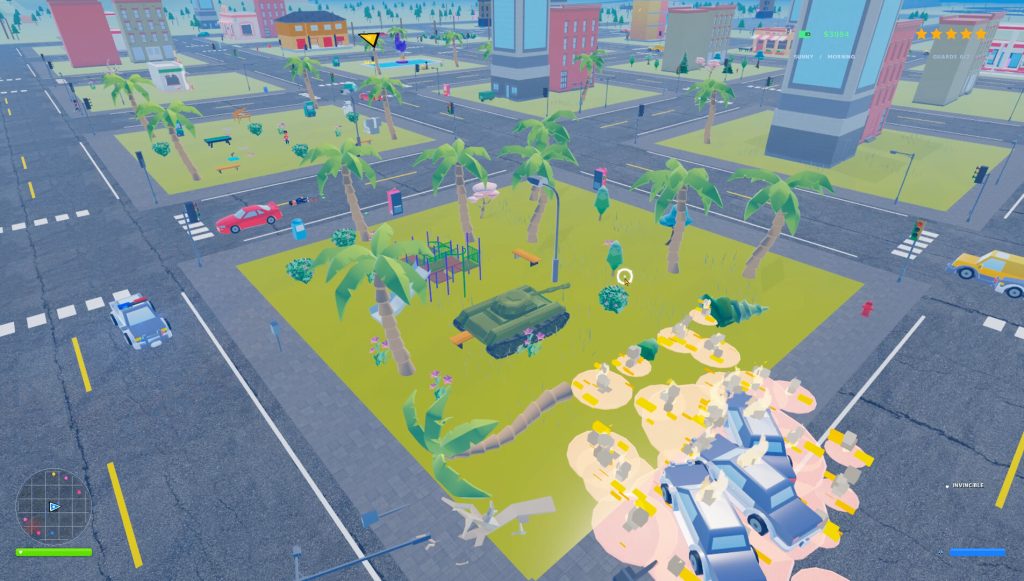
Developed by BuBa Games, the upcoming PC game mixes third-person and classic top-down perspectives with missions, police chases, rival gangs, recruitable bodyguards and plenty to do when you are not actively making yourself a problem for local law enforcement. Shops and businesses can be entered, while bowling, billiards and arcade games offer distractions from whatever criminal enterprise you were probably supposed to be concentrating on.
There is another aspect of the project worth discussing too. BuBa Games openly discloses the use of generative AI during development for some pre-generated 2D artwork, text editing, localisation and development support. At a time when the role of AI in game development remains a contentious subject, particularly within the indie community, that raises some interesting questions about where Burhan Doygun of BuBa Games draws the line, why those tools were used and how developers should approach transparency around them.
So, we caught up with Burhan to talk about building Cartoon Crime, recapturing some of that old-school open-world freedom, the realities of creating an ambitious indie project, and why AI became one of the tools used along the way.
Cartoon Crime gameplay video
Before we start causing trouble around the city, could you introduce yourself, tell us a little about your background, and explain how BuBa Games and Cartoon Crime came about?
I’m Burhan Doygun, and I’m one of the two people behind BuBa Games. We are a very small independent team, so Cartoon Crime is a very personal project for us.
The idea started from something quite simple: we wanted to make the kind of open-world game we enjoy playing ourselves. A game where the world does not constantly tell you what you should be doing next. You can follow the missions, but you can also wander off, explore a building, start trouble with the police, play a mini-game or simply see what is happening around the next corner.
As development continued, that simple idea kept growing. We added the ability to switch perspectives, enterable locations, bodyguards, mini-games, different districts and other systems, but we have always tried to keep that original feeling of freedom at the centre of the game.
We are a tiny team, so making something with this scope is definitely challenging, but it is also what makes the project exciting for us.
Cartoon Crime seems very deliberately interested in that older style of open-world crime game where half the fun was ignoring the mission marker and seeing what trouble you could create. What games or experiences originally inspired the project?
Older open-world crime games were a big inspiration, especially the freedom they gave players to forget the mission and just explore or cause chaos.
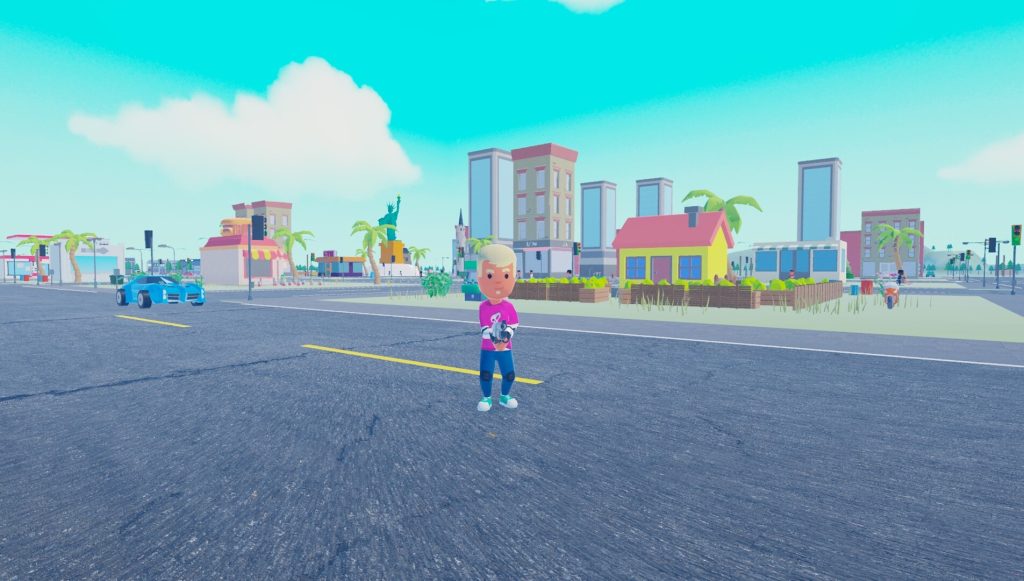
Of course, we are not saying Cartoon Crime is anywhere near the scale or quality of games like GTA III, Vice City or San Andreas. We are a tiny indie team. What we want to capture is a similar feeling of freedom, but in our own colourful, cartoony world.
One of the more distinctive choices is letting players switch freely between third-person and top-down perspectives. Was that born from wanting to bridge different eras of crime games, and does changing the camera meaningfully change how Cartoon Crime feels to play?
Yes. Third-person feels more immersive, while top-down gives the game a more classic, arcade-like feeling. We wanted players to freely choose whichever perspective they enjoy.

There is quite a lot packed into the city beyond the main missions, including shops, gyms, arcades, bowling and billiards. How important was it that Cartoon Crime’s world feels like somewhere players can actually spend time rather than simply a large map connecting one mission to another?
Very important. We want the city in Cartoon Crime to feel like somewhere you can actually spend time, not just a map between missions. Sometimes simply walking into a bowling alley or arcade should be part of the fun.
Mini-games can sound like a small detail, but they often end up becoming the things players strangely obsess over. How deep do you want activities such as bowling, billiards and the arcade machines to go?
We want them to be simple to understand but enjoyable enough that players might genuinely get distracted by them. They do not need to be huge simulations; they just need to feel fun and worthwhile. The idea actually comes from a childhood memory of playing San Andreas. I remember going into a shop, seeing an arcade machine inside and being able to actually play it. I loved that small detail.
That feeling stayed with me, so in Cartoon Crime we wanted activities like arcade games, bowling and billiards to be simple, fun distractions that make the world feel more alive.
Recruitable bodyguards are another fun idea in Cartoon Crime. How much control will players have over building their crew, and do different characters bring their own strengths, personalities or problems with them?
For now, players can recruit up to seven bodyguards. Some are much stronger than others, and that is reflected in their recruitment cost.
The player also has a simple skill system. After every 25 kills or destroyed vehicles, you earn one skill point that can be spent on small upgrades such as movement speed, damage, or reducing bodyguard recruitment costs.
Technically, we could allow players to command a much larger group, almost like a small army, but we felt that would move Cartoon Crime away from its main focus. We may expand the system later if we find ideas that genuinely make it more fun rather than simply bigger.
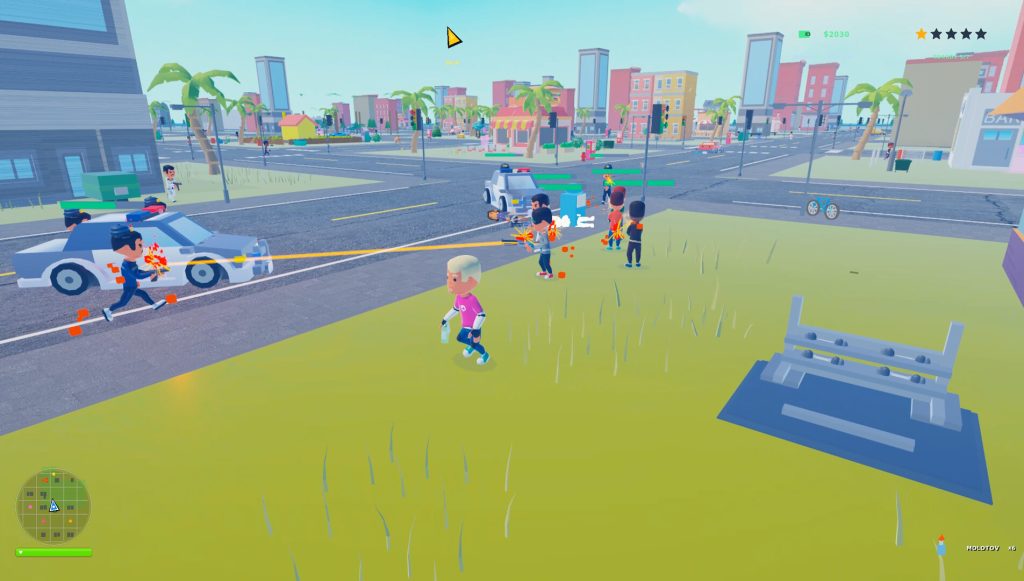
Police wanted systems are almost a game within a game in this genre. What have you done to make escalating chases interesting, and how far can things spiral if the player absolutely refuses to behave themselves?
For now, the wanted system is quite close to the older GTA-style approach, and it works well for the kind of game we are making. As the level increases, the police response becomes much more aggressive, while players can also find stars around the streets that reduce their wanted level.
We may change or expand this system later, especially if we find a good alternative for players who prefer a different way of escaping the police. For now, though, the simple classic system fits Cartoon Crime very well.
You are also promising multiple playable characters, districts, dynamic weather, day-and-night cycles, indoor locations and several other systems. That is an ambitious amount for an indie project. How do you stop the scope from running away with you, and have there been ideas you have deliberately had to cut or postpone?
Cartoon Crime is definitely ambitious for a team as small as ours, so we try to be realistic about what we can do well. We have built our own engine in C++ and OpenGL, which lets us create the world parcel by parcel and gives us a lot of freedom, but it also means a lot of work.
We are open about using AI tools to support some coding and development tasks, but the game still represents thousands of hours of human work, testing, fixing and bringing everything together.
We have already simplified or postponed some ideas when they became too large for the project. We are not trying to compete with huge open-world games. We just hope to make a small, enjoyable old-school crime game in a cartoony world where players can explore and create a little chaos.
I also want to talk about your generative AI disclosure, because you have been upfront about using AI tools for some pre-generated 2D artwork, text editing, localisation and development support. What led you to start using those tools, and what problems were you trying to solve with them?
Being such a small team, we started using AI mainly as a support tool for coding assistance, text editing, localisation and some pre-generated 2D artwork.
But even with AI, you still have to solve thousands of problems and spend countless hours building, testing, fixing and connecting everything together. At least for now, AI cannot simply make a game like this for you.
For us, it is just a tool that helps with certain parts of development. The actual game still depends on human decisions, review and a lot of work.
There is considerable disagreement within indie development around generative AI, with some developers particularly concerned about its impact on artists, the provenance of training material and whether it devalues creative work. How do you respond to developers who believe AI-generated assets simply should not have a place in indie games?
I completely understand those concerns, especially from artists, and I respect developers who choose not to use generative AI at all.
For us, it is a support tool rather than a replacement for creativity. We use it in limited areas; we are transparent about it, and everything that goes into the game is reviewed and adjusted by us.
I do not think there is one answer that every indie developer has to agree with. The technology is still developing, and the discussion around how it should be used is important. We can only be honest about how we use it and make sure the final creative decisions remain ours.
Your disclosure says everything for Cartoon Crime that is AI-assisted is reviewed, edited and approved before being included. Where do you personally draw the line between using AI as a development tool and allowing it to become the creative voice of the project?
For me, the line is quite simple: AI can help us solve problems or speed up certain tasks, but it should not decide what Cartoon Crime is.
The ideas, gameplay, atmosphere, world and final creative choices come from us. Anything AI-assisted still has to be reviewed, edited and made to fit the game properly.
If we just accepted whatever AI produced without our own judgement, then it would start becoming the creative voice. That is not how we want to work.
Specifically regarding the 2D artwork, how much of what players actually see begins with generative AI, and what work happens between that initial output and something being considered finished enough to appear in Cartoon Crime?
Only some of the 2D artwork starts with generative AI. It is not the whole visual side of the game.
The first output is usually just a starting point. We still review it, edit or correct it, resize and adapt it, and make sure it fits the style and the rest of the world. Sometimes we try many versions before finding something usable, and sometimes we simply throw it away.
For us, the important part is that everything looks consistent together. AI can create an image, but it cannot automatically understand the whole game and make everything feel harmonious — that still requires human judgement and a lot of work.
Transparency is becoming an important part of this conversation too. Do you think developers who use generative AI have a responsibility to tell players exactly where and how it has been used, rather than simply ticking a disclosure box and moving on?
Yes, I think transparency is important. If AI has been used in development, players should be able to understand where and how it was used.
That is why we try to be clear about using it for some pre-generated 2D artwork, text editing, localisation and development support. We are not trying to hide it behind a simple checkbox.
At the same time, I think the explanation should be practical and honest rather than making AI sound like it created the game. It is one of the tools we used, while the final decisions, review and responsibility remain with us.
Putting the AI discussion within the wider reality of development, has working on Cartoon Crime changed your view of what one developer or a small indie team can realistically accomplish? What has proved considerably harder than you expected when you first imagined the game?
Definitely. Working on Cartoon Crime showed us that a very small team can achieve much more than we first expected, especially with modern tools, but it still requires a huge amount of time and patience.
The hardest part has not been creating individual features, but making all the systems work together properly. You solve one problem and often create two new ones somewhere else.
Building our own engine, world systems, missions, AI, interiors, weather and everything around them has meant solving thousands of small problems. That part is much harder than it looks from the outside, but it is also what makes development interesting.
Finally, Cartoon Crime is offering missions, exploration, mini-games, police chases, bodyguards and plenty of opportunities to simply create your own chaos. When someone eventually puts the game down after their first proper session, what do you most hope they have enjoyed about the experience?
I hope they simply had fun and felt free to play in their own way.
For some players, Cartoon Crime might even become the kind of game they open just to relax, switch off for a while and create some chaos. That is actually how I personally played GTA most of the time — not always following missions, but just driving around, getting into trouble and seeing what happened.
If Cartoon Crime can give players even a little of that feeling in its own cartoony world, I would be very happy.

A big thank you to Burhan Doygun for taking the time to speak with us about Cartoon Crime.
There is something immediately familiar about its promise of an open city, rising wanted levels and the temptation to completely ignore whatever you were supposed to be doing because you spotted an arcade on the other side of the road. At the same time, switching between third-person and top-down play allows BuBa Games to put its own spin on a formula with a very long history.
The use of generative AI will inevitably be part of the conversation around the game too, and it is an area where players and developers have increasingly strong opinions. Being transparent about those tools is important, but so is asking what they contribute, where their use should stop and what responsibilities developers have when choosing to work with them.
Ultimately, Cartoon Crime will have to stand on what players experience when they step into its city.
And if the first thing everyone does is ignore the story, recruit a few bodyguards, upset the police and disappear into a bowling alley, that might just mean Burhan has captured the spirit he was aiming for.
Want to see which other folk in the gaming industry we’ve been chatting to? Head over to our interviews section.